Absolute gravimeter field gravity station fixed point measurement - Xinjiang (Other fixed-point measurements)
WF-T-1 Absolute Gravimeter (Hardware and Software Introduction)
From January 23, 2018, to January 29, 2018, at the Gravity Room of the Xi'an Seismic Station, T-1 type absolute gravimeter
Conducted absolute gravity observations for a total of 125 hours. The image below shows the T-1 type absolute gravimeter at the testing site in Xi'an.
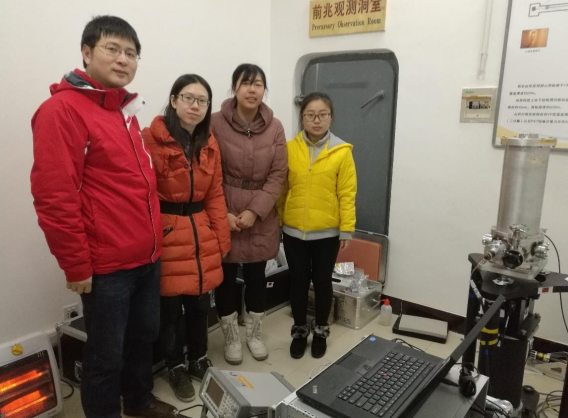
From January 23, 2018, to January 29, 2018, at the Gravity Room of the Xi'an Seismic Station, T-1 type absolute gravimeter
This measurement is divided into two groups. The first group starts from UTC time 2018-01-23 08:06:22 and ends on 2018-01-25.
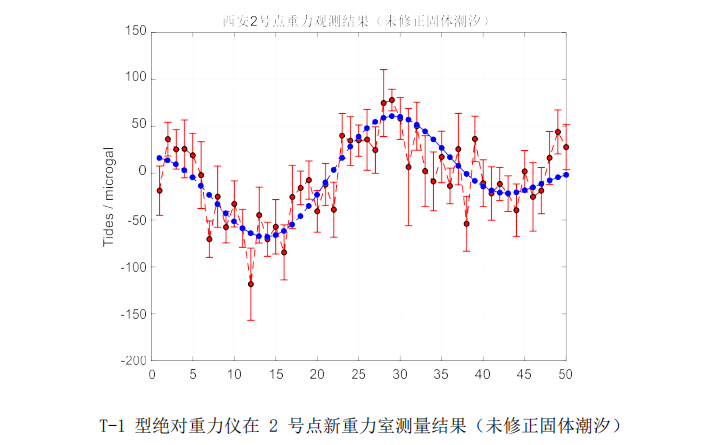
12:47:59 ended, with a total of 159 sets of data measured, 3 sets per hour, each set measured consecutively 25 times (i.e., the free fall occurred 25 times consecutively). The second set started at UTC time 2018-01-26 06:40:30 and ended at 2018-01-29 06:12:06, with a total of 144 sets of data measured, 2 sets per hour, each set measured consecutively 25 times. The pause in between was due to cumulative motion errors of the vacuum drop mechanism, which can be resolved later through automatic daily zero-point calibration. The following two figures show the measurement results of the first set of data. Among them, because the instrument has not yet adapted to the ambient temperature, data sets 1 to 19 fluctuated widely; additionally, when an electric heater was newly placed in the room where the instrument is located, the ambient temperature gradually increased, causing a noticeable half-cycle fluctuation in data sets 20 to 64. From data set 65 onward, the instrument was stable. To improve the accuracy of calculations, we selected data starting from set 65 for processing. As shown in the second figure, the group averages of these data, without tidal corrections, match the theoretical tides quite well.
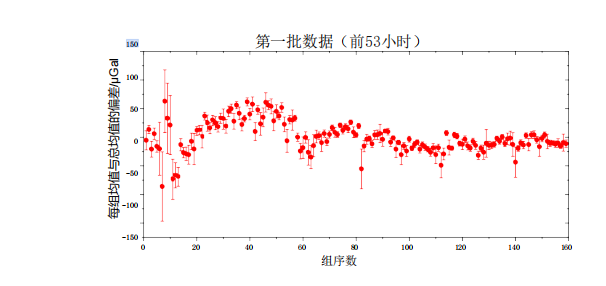
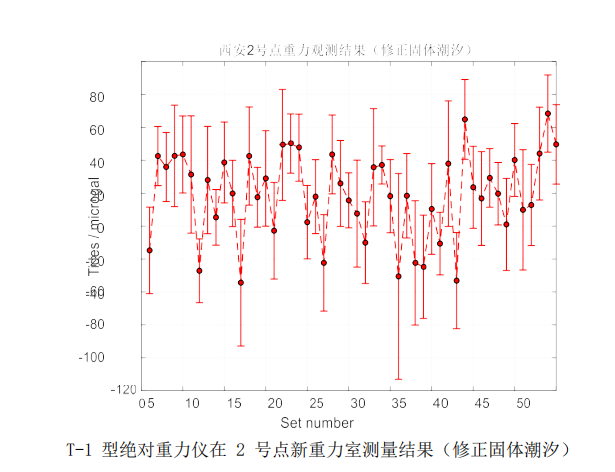
Measurement results of the first batch using the T-1 absolute gravimeter in the gravity room of the Xi'an Seismic Station (corrected for solid Earth tides)
The first batch of data (first 53 hours, starting from the 21st hour)
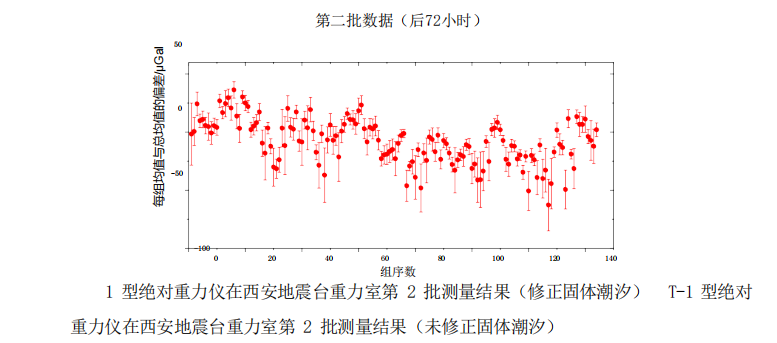
The deviations of the mean measurements of each group in the second batch of data (tidally corrected) from their overall mean are as follows
This batch of data shows no significant or drastic fluctuations and can therefore be entirely used for data processing. However, the deviation values shown in the figure still exhibit a certain periodicity, which is likely due to incomplete tidal correction. One possible cause of this phenomenon is an error in the computer's internal clock, which is 5 minutes faster than UTC time, making the theoretical tidal calculations inaccurate (there is a certain time difference). This issue will be addressed in further data processing. The second figure shows that the group mean of these data, without tidal correction, basically matches the theoretical tides. According to the data processing program, the measured mean and standard deviation of the two batches of data were obtained, and after correction for Type B uncertainty and calculation of the total uncertainty, the final measured gravity values at the ground gravity points indicate that the uncertainty of both the first and the second batches of data is ±4.8 μGal. After processing the two batches of data together, the resulting uncertainty is ±4.7 μGal. Comparing the mean measurement results with the reference gravity acceleration values provided by the Xi'an Seismological Station, the deviation is within twice the combined instrument uncertainty, so the measurements from the T-1 absolute gravimeter are consistent with the reference values.
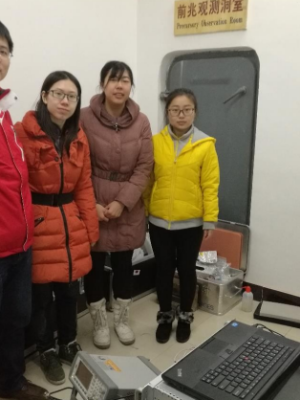
From December 30, 2019, to January 2, 2019, the T-1 absolute gravimeter conducted absolute gravity observations again at the old gravity room (referred to as Point 1) of the Xi'an Seismological Observatory, and also at the newly built nearby gravity room (Point 2). Both points were measured continuously for 25 hours. The first image below shows the T-1 absolute gravimeter at the test site in the old gravity room (Point 1) of the Xi'an Seismological Observatory, and the second image below shows the T-1 absolute gravimeter at the test site in the new gravity room (Point 2) of the Xi'an Seismological Observatory.
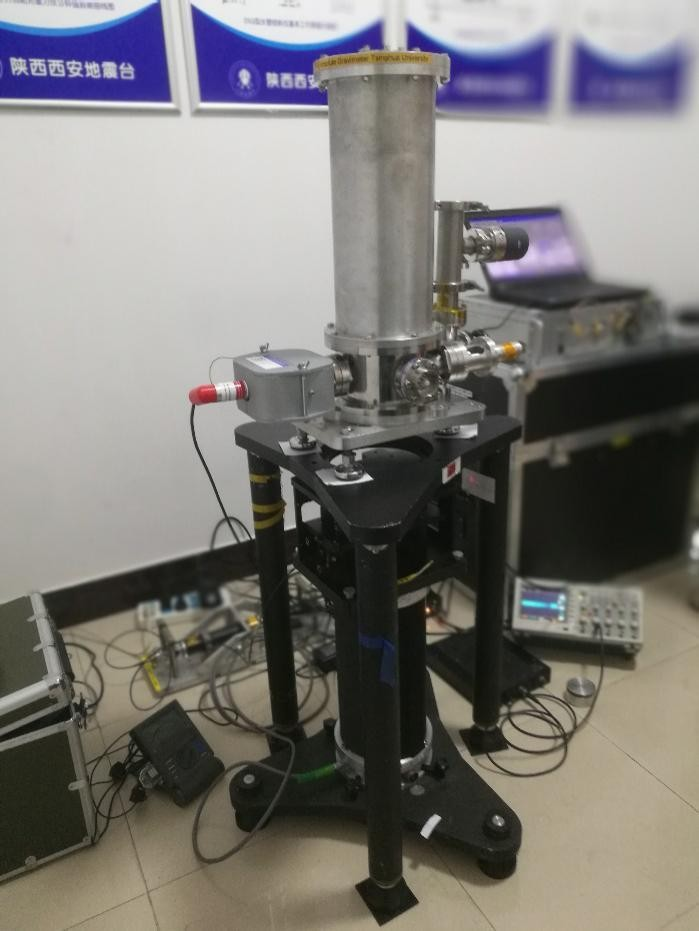
T-1 absolute gravimeter in the old gravity room of Xi'an Seismic Station (December 30, 2019)
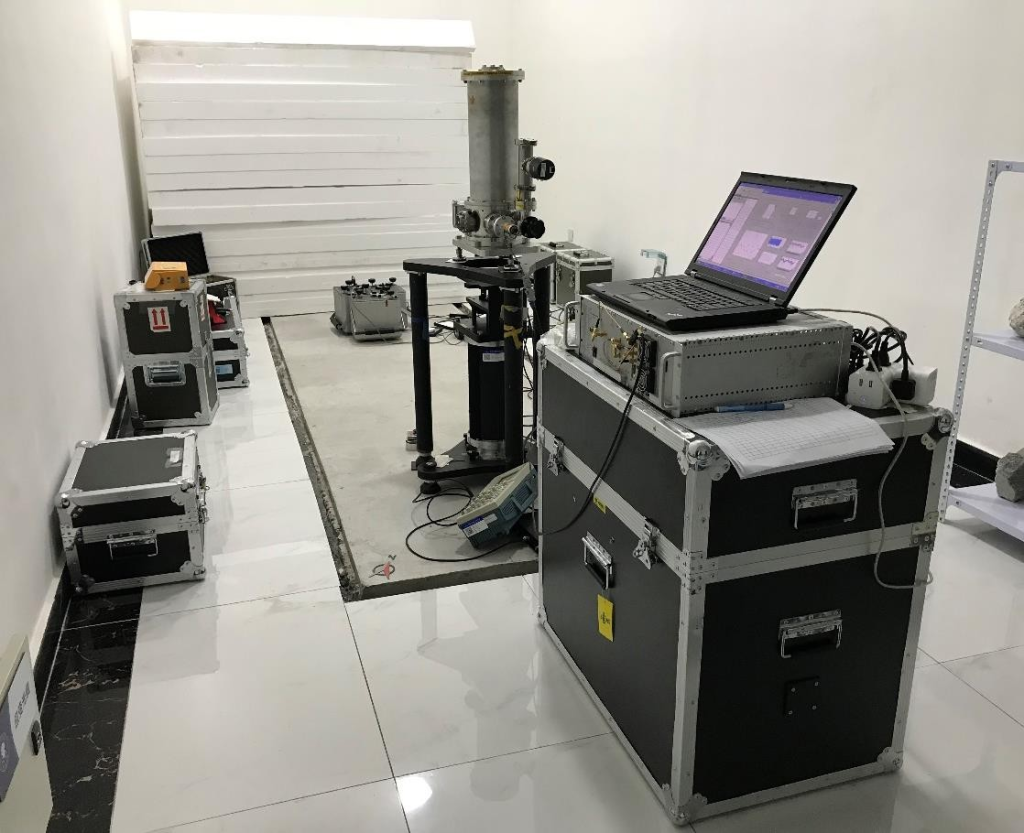
T-1 absolute gravimeter in the old gravity room of Xi'an Seismic Station (December 30, 2019)
From December 30 to 31, 2019, the T-1 absolute gravimeter conducted absolute gravity measurements at Point 1 in the old gravity room, and the results are shown in Figures 1 and 2. From January 1 to 2, 2020, the T-1 absolute gravimeter conducted absolute gravity measurements at Point 2 in the new gravity room, and the measurement results are shown in Figures 3 and 4.
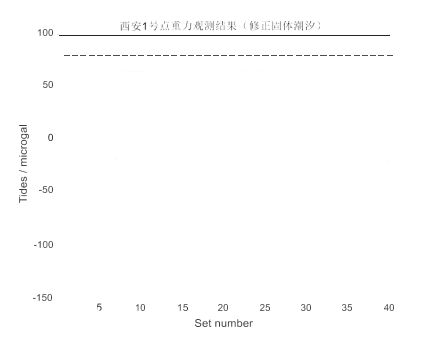
Results of the T-1 absolute gravimeter measurements at point No. 1 in the old gravity room (solid tide corrected)
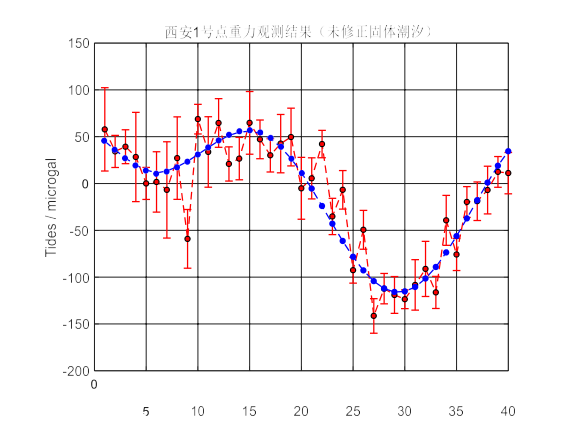
Results of the T-1 absolute gravimeter measurements at point No. 1 in the old gravity room (solid tide corrected)