
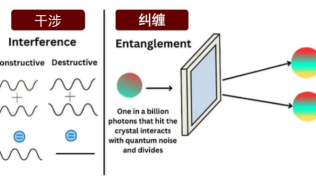
Quantum computing is a cutting-edge technology that uses the unique properties of quantum mechanics to process information. Its core principles mainly include superposition, interference, and entanglement. The combination of these three gives quantum computers powerful computational capabilities, far surpassing the limits of classical computers in certain specific tasks.
叠加(Superposition)
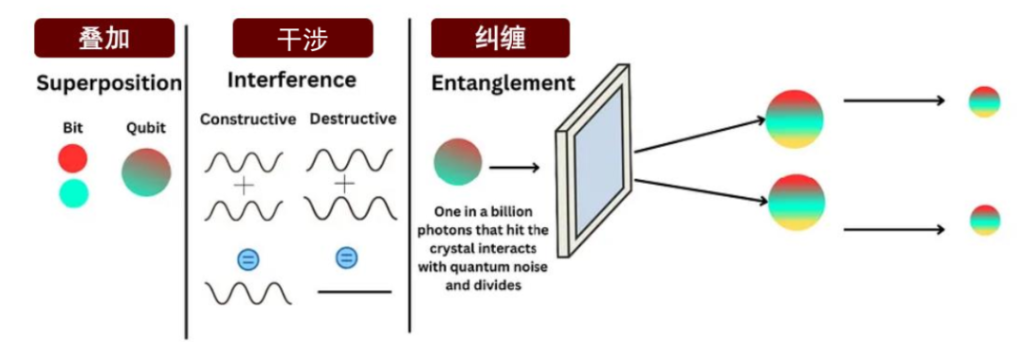
In traditional computers, a bit can only be in one of two states, 0 or 1, whereas a qubit in a quantum computer can utilize the principle of superposition to be in multiple states simultaneously. This characteristic allows qubits to represent multiple possibilities at the same time, greatly enhancing the parallelism of information processing.
For example, a qubit can exist in a superposition of both 0 and 1 at the same time, and two qubits can simultaneously represent four states (00, 01, 10, 11). Similarly, n qubits can simultaneously represent 2^n states. This exponential information capacity gives quantum computers a natural advantage in handling large-scale parallel computations.
干涉(Interference)
The principle of interference plays a role in controlling quantum states in quantum computing. Quantum computers cleverly design quantum gate operations so that different quantum states produce constructive or destructive interference during the computation process. Constructive interference enhances the probability of correct results, while destructive interference suppresses the probability of incorrect results.
This interference effect is similar to the superposition of water waves: when a crest meets another crest, the amplitude increases; when a crest meets a trough, the amplitude decreases. In quantum algorithms, interference is used to amplify the quantum states along the correct paths while canceling out the quantum states along the incorrect paths, thereby improving computational accuracy and efficiency. For example, in the quantum Fourier transform and quantum search algorithms, interference effects are key to achieving fast computation.
纠缠(Entanglement)
Quantum entanglement is one of the most mysterious and fascinating phenomena in quantum mechanics. When two or more qubits become entangled, a strong correlation forms between them, such that no matter how far apart they are, measuring one qubit will immediately affect the state of the other qubit.
This non-local correlation property gives entangled states a crucial role in quantum computing. Through entanglement, quantum computers can achieve remote manipulation and information transfer between qubits, providing powerful tools for quantum communication and quantum computation. For example, in quantum teleportation, entangled states are used to transmit unknown quantum states remotely; in quantum computing, entangled states are used to achieve parallel computation and quantum error correction.
The three core principles of quantum computing—superposition, interference, and entanglement—together form the foundation of a quantum computer's powerful computational capabilities. Superposition provides exponential information capacity, interference allows precise control of quantum states, and entanglement grants long-range correlations and manipulative abilities between qubits. The organic combination of these three enables quantum computers to show immense potential in solving complex problems that are difficult for classical computers to handle, such as large number factorization, quantum simulation, and optimization problems.
With the continuous development of quantum technology, quantum computers are expected to play an important role in fields such as materials science, drug development, financial modeling, and artificial intelligence. However, quantum computing still faces many challenges, such as the stability of qubits, quantum error correction, and the optimization of quantum algorithms.